From Qualification to Private Practice: Navigating the In-Between
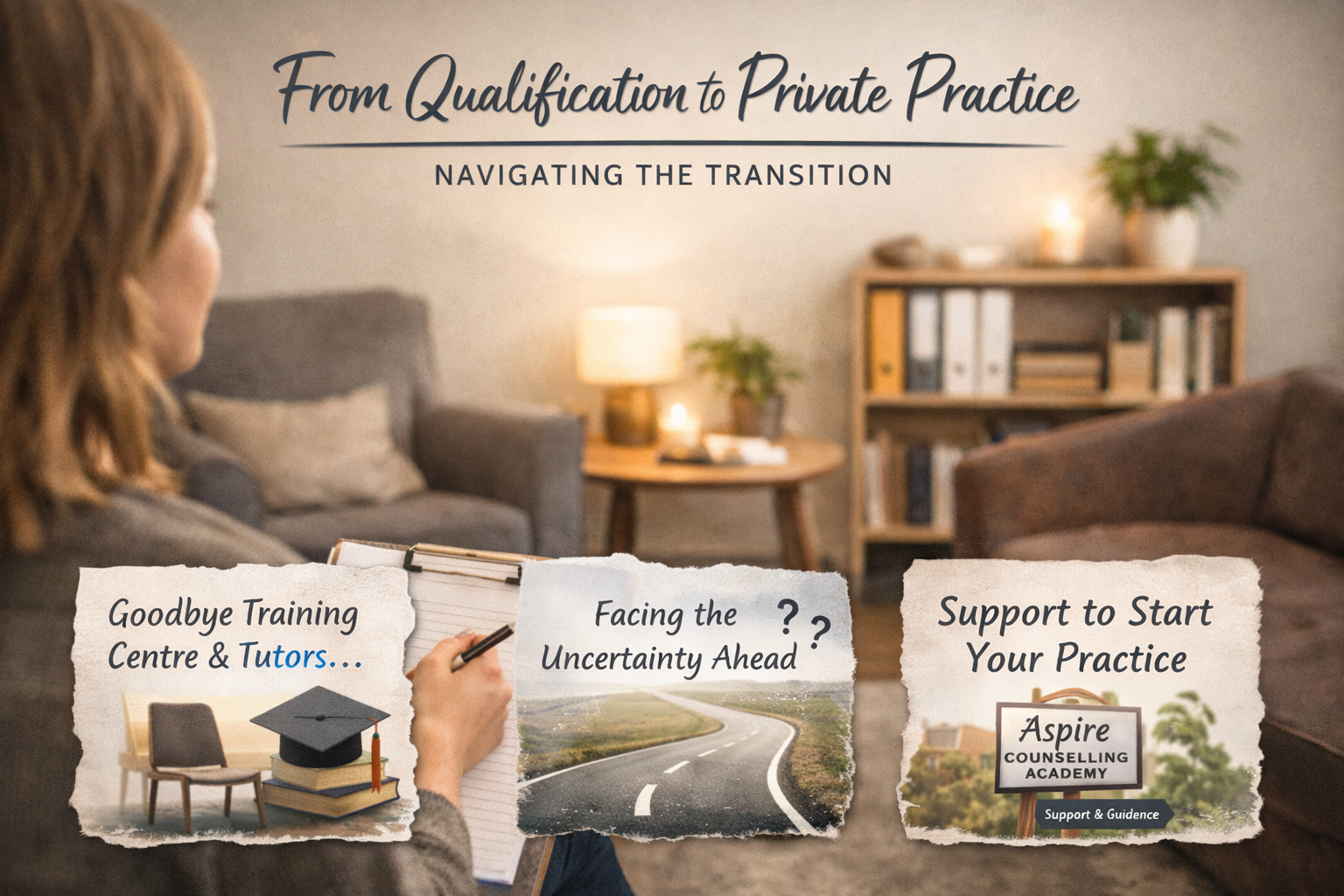
There’s a moment that often doesn’t get talked about enough in counselling training.It’s not the first day of your course.
It’s not your first client.
It’s not even the moment you pass.
It’s what comes after.
Because when you qualify as a counsellor, something profound happens — not just professionally, but personally too. You’ve spent years developing self-awareness, learning theory, sitting in discomfort, growing through feedback, and being held within a training group that becomes, in many ways, a psychological home.
And then… it ends.
The Unexpected Loss After Qualification
For many newly qualified counsellors, finishing training isn’t just an achievement — it’s also a loss.
You lose your weekly structure.
You lose the familiarity of your training room.
You lose regular contact with tutors who have guided and supported you.
You lose a peer group who truly gets it.
Training is immersive. It’s relational. It’s containing.
And when it ends, the transition into “being a counsellor” can feel far more abrupt than expected.
There’s often an assumption that once you qualify, you’re ready — confident, clear, and equipped to step straight into private practice.
But the reality is often very different.
“Am I Ready for This?”
Newly qualified counsellors frequently sit with questions like:
- How do I actually get clients?
- Where do I work from?
- What do I charge?
- What paperwork do I need?
- What if I get it wrong?
- Am I even ready to do this without my tutors there?
These aren’t small questions. They’re foundational.
And yet, many practitioners find themselves navigating them alone.
Even though core practitioner training equips you with the skills, ethics, and competence to work with clients , it doesn’t always prepare you for the business and practical realities of setting up independently.
This is the gap.
The Gap Between Qualification and Practice
Training prepares you to be a counsellor.
But it doesn’t always prepare you to run a practice.
And this is where many newly qualified practitioners can feel stuck — not because they lack ability, but because they lack structure, confidence, and support in those early steps.
It’s a vulnerable space.
You’re no longer a student.
But you don’t quite feel like an established practitioner either.
You’re in-between.
The Fear of Starting Alone
One of the biggest barriers to entering private practice isn’t competence — it’s isolation.
Without a training environment, it’s easy to feel like you’re:
- second-guessing yourself
- unsure about professional decisions
- hesitant to put yourself out there
- overwhelmed by the “business” side of counselling
And perhaps most significantly — you no longer have that immediate, informal support network.
No tutor to check in with after a difficult session.
No group to reflect alongside weekly.
No shared space where you feel understood.
This can slow people down — sometimes for months, even years.
Why Private Practice Still Matters
Despite these challenges, many counsellors are drawn to private practice for good reason.
It offers:
- autonomy and flexibility
- the ability to shape your own way of working
- opportunities to specialise
- direct connection with clients outside of organisational constraints
And for many, it represents the natural next step after qualification.
But stepping into private practice shouldn’t mean stepping into isolation.
A Different Way to Begin
What if the transition didn’t have to feel like a cliff edge?
What if there was a bridge between training and independent practice?
That’s exactly the intention behind Aspire Counselling Academy’s Counsellor Practice Start Programme.
Designed specifically for newly qualified counsellors (and those approaching qualification), it recognises that the early stages of private practice aren’t just about logistics — they’re about confidence, identity, and support.
A Supported Pathway Into Practice
The programme offers a 6-month structured pathway into private practice, giving newly qualified counsellors both the practical tools and the emotional support needed to begin working independently.
Rather than leaving practitioners to “figure it out”, it provides a gradual, supported entry into real-world practice.
This includes:
A Professional Space to Start
Having somewhere to work is one of the biggest initial barriers.
The programme includes up to 2 hours of counselling room use per week, allowing you to begin seeing clients in a consistent, professional environment.
This removes the uncertainty of:
- where to see clients
- how to present yourself professionally
- whether you’re “ready” to step into a real therapy space
Instead, you’re supported in taking that step — gently, but confidently.
Monthly Practice Builder Support
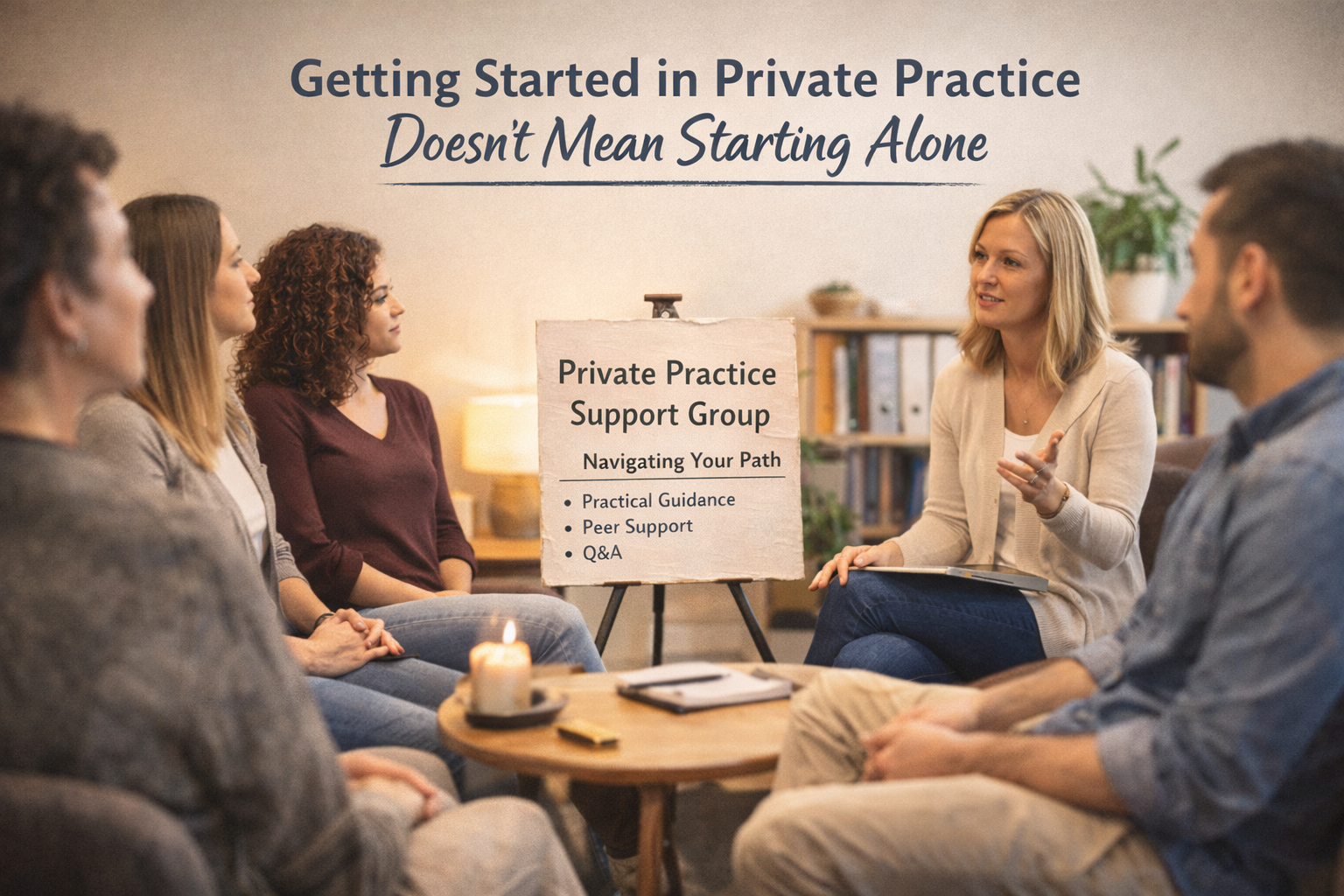
Perhaps one of the most important elements is the monthly facilitated practice-building group.
These sessions focus on the realities that training doesn’t always cover, including:
- getting your first clients
- managing enquiries and boundaries
- understanding insurance and registration
- working ethically and confidently in private practice
But more than that, they recreate something many newly qualified counsellors miss deeply:
a sense of community.
A space to reflect, ask questions, share experiences, and realise you’re not alone in how you’re feeling.
Practical Resources That Remove Guesswork
Starting private practice often comes with an overwhelming list of admin tasks.
Contracts.
Forms.
GDPR.
Policies.The programme provides essential templates and documentation, including:
- client contracts
- intake forms
- privacy and GDPR documents
This means you’re not starting from scratch — or worrying whether you’ve “missed something important.”
Building a Professional Identity
Another challenge after qualification is visibility.
How do you present yourself as a practitioner?
The programme supports this by offering:
- the ability to use the Aspire address as your practice location
- the opportunity to be listed as an Aspire Affiliated Practitioner
These may seem like small details — but they can significantly impact confidence, credibility, and client trust in those early stages.
Replacing What Was Lost — Not Replicating It
It’s important to say: nothing fully replaces the experience of training.
The intensity, the group process, the depth of personal growth — that’s unique.
But what can be recreated is:
- support
- structure
- connection
- guidance
And these are exactly the elements that help newly qualified counsellors move forward.
Confidence Comes From Doing — But Not Alone
There’s a common belief that confidence comes before action.
In reality, it often comes through action.
But that action needs to feel safe enough to take.
A supported start allows you to:
- take your first clients without feeling exposed
- make decisions with guidance available
- build confidence gradually, rather than all at once
And crucially — to develop your identity as a practitioner in a way that feels authentic, not rushed.
You Don’t Have to Rush — But You Do Need to Begin
Some newly qualified counsellors delay starting private practice because they feel “not ready enough.”
Others jump in quickly but feel overwhelmed and unsupported.
There is a middle ground.
A space where you can begin, grow, and develop at your own pace — with support alongside you.
A Gentle Transition Into Your Next Chapter
Becoming a counsellor doesn’t end with qualification.
In many ways, that’s where it truly begins.
But beginnings need containment.
They need support.
They need structure.Without that, it’s easy to feel lost.With it, the transition becomes something very different:
- less daunting
- more grounded
- more sustainable
Final Thoughts
If you’ve recently qualified — or are approaching qualification — and find yourself feeling uncertain, overwhelmed, or even a little lost…
You’re not alone.
And more importantly — there’s nothing wrong with you.
You’re in a transition.
A significant one.
And transitions are not meant to be navigated in isolation.
Private practice is possible.
Confidence is possible.
Growth is inevitable.
But support makes all the difference in how you get there.